Colonial Stage

The astronomy building of the Manila Observatory, circa 1895.1

The Jesuits established the Manila Observatory in 1865. Directed by Padre Federico Faura, it observed weather patterns and began issuing typhoon warnings in 1879, by 1880 it observed earthquakes as well. It was recognized by the Spanish government as the official Philippine institution for weather forecasting in 1884. The American then established it as the Philippine Weather Bureau in 1901, and it remained so until its equipment and data were destroyed by the Second World War. It was rebuilt in 1951 in Baguio, and later transferred to Loyola Heights within the Ateneo de Manila University. It currently conducts research on seismic, geomagnetic, radio and solar physics.2,3

Portrait of Anacleto del Rosario4

Anacleto del Rosario was a Filipino chemist during the Spanish colonial period, and is now regarded as the Father of Philippine Science and Laboratory.5 In 1888, the Laboratorio Municipal de Manila was established and he was named director. The laboratory had a section dedicated to perform chemical analysis on drinking water, pharmaceuticals and food materials named Laboratorio del Analisis Quimico.6, 7

Class of senior nurses being taught operating room techniques at the Philippine General Hospital.8

The United States colonial government adopted a policy of “benevolent assimilation” that is dedicated for the pacification of the Filipinos. A public school system was established, as well as trade schools. Notably, many nursing schools were opened. Filipinos were trained with English and up-to-date medical knowledge stateside. They were then offered job opportunities in the United States, which resulted in their immigration and the formation of a Filipino diaspora in the states.9

A Filipino farmer planting rice.10

Research and development during the American colonial period was directed to agriculture, food processing and pharmaceuticals. Little to no investments were made for local industries as the Philippines was made a direct importer of finished goods from the United States.11, 12 To this day, the Philippines is lagging behind other countries in manufacturing, it remains an exporter of raw materials and an importer of finished goods, as evidenced by our local abaca fiber industry, used for the manufacturing of surgery grade face masks, yet we have experienced a shortage of these masks during the early days of the pandemic.

Sources:

“Manila Observatory,” in Manila Nostalgia, April 28, 2013, http://www.lougopal.com/manila/?p=561.

“History,” Manila Observatory, http://www.observatory.ph/about/.

Crisanto M. Lopez. Science and Technology in the Philippines (Ateneo de Manila University, 2018).

Warwick Anderson. “Immunization and Hygiene in the Colonial Philippines,” Journal of the History of Medicine and Allied Sciences 62(1) (2007), 1-20, https://doi.org/10.1093/jhmas/jrl014.

Anne Rice. “Why are there so many Filipino nurses in the U.S.?” Berkley News, May 28, 2019. https://news.berkeley.edu/2019/05/28/filipino-nurses-in-the-us-podcast/.

Christina Thornell. “Why the US has so many Filipino nurses,” Vox, June 30, 2020. https://www.vox.com/2020/6/30/21307199/filipino-nurses-us.
Pre-colonial Stage

The first map of the Philippines, made by Petrus Kaerius (1598).1
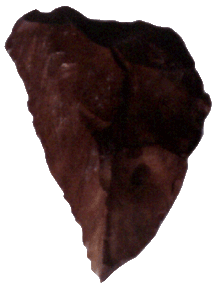
A stone tool dated to the Old Stone Age, excavated from Cagayan.2

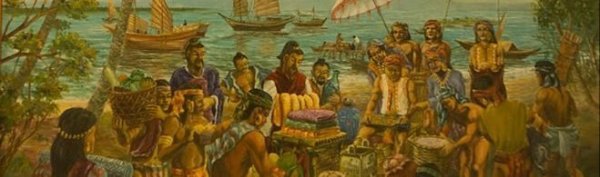
Tools for sawing and drilling, as well as weapon implements, were excavated and taken as evidence for settlement during the Stone Age and primitive technology.3 Long before the arrival of the Spaniards, Philippine natives already had close commercial contact with neighboring communities in Southeast Asia, China and even as far as Japan.

Orion’s Belt (Dela Orionis is zoomed in).4
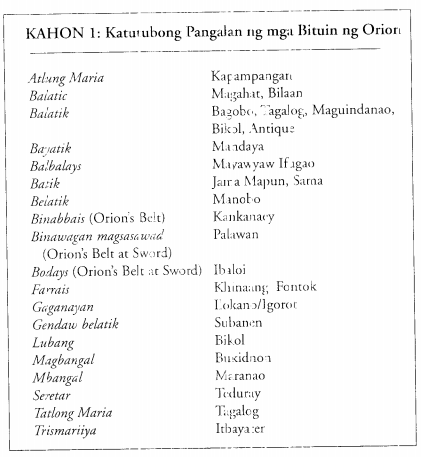
Native Names of Stars in Orion’s Belt.5

Natives used constellations for timekeeping6 such as tracking seasons for agricultural purposes3 and social functions7. Indigenous people since time immemorial have used knowledge of the movement of heavenly bodies for essential facets of civilization, and so the field of study dedicated to this native astronomy was born, ethnoastronomy5.

The Laguna Copper Plate.8

The Laguna Copper Plate is the earliest document that reveals the earliest use of mathematics. It is dated to be written in the late 9th century. And It is written in an ancient Malay Language, using the Old Kawi Script, detailing the absolution of a nobleman and his family of debts.9

Sources:

  1. Patricia Lazo Vega. “Charted territories: the Philippines as depicted in old maps,” GMA News, July 4, 2012, https://www.gmanetwork.com/news/lifestyle/artandculture/264136/charted-territories-the-philippines-as-depicted-in-old-maps/story/.
  2. “Flake Tools,” National Museum of the Philippines, las modified February 10, 2014, https://www.nationalmuseum.gov.ph/nationalmuseumbeta/Collections/Archaeo/Flake.html.
  3. Crisanto M. Lopez. Science and Technology in the Philippines (Ateneo de Manila University, 2018).
  4. Molly Porter. “More Than Meets the Eye: Delta Orionis in Orion’s Belt,” National Aeronautics and Space Administration, last modified August 7, 2017, https://www.nasa.gov/mission_pages/chandra/more-than-meets-the-eye-delta-orionis-in-orions-belt.html.
  5. Dante L. Ambrosio. “BALATIK: Katutubong Bitiun ng mga Pilipino,” Philippine Social Sciences Review 57, nos. 1-4 (2005). https://bangkanixiao.files.wordpress.com/2012/09/ambrosio-balatik-katutubong-bituin-ng-mga-pilipino.pdf
  6. William Henry Scott. “Natural Science,” in Barangay: 16th Century Philippine Culture and Society, (Ateneo de Manila University Press, 1994) 121-124.
  7. Chang Casal. “5 unique things Filipinos believed about the sun, moon, and stars,” CNN Philippines, January 23, 2019, https://cnnphilippines.com/life/culture/2019/01/22/Filipinos-astronomy-beliefs.html?fbcid.
  8. “The Laguna Copperplate Inscription,” Wikipedia, December 2, 2017, https://commons.wikimedia.org/wiki/File:Inskripsyon_sa_Binatbat_na_Tanso_ng_Laguna.jpg.

Blog at WordPress.com.

Up ↑

Design a site like this with WordPress.com
Get started